

TECHNICAL AREA
Discover our quality policy
Certifications
Our quality is certified and controlled
View our quality policy
CERTIFIED QUALITY MANAGEMENT SYSTEM
Nr. 50 100 12985 - Rev 003
Our company applies a precise and complex quality management system through the application of the ISO 9001-2015 standard.
This results in:
- High qualitative standards through accurate controls of the company management system
- Continuous improvements based on evidence
- Focus on customer needs
- Management of business relations
- A careful supplier selection and monitoring
Many of our spindles are manufactured according to technical specifications/drawings, with dimensional and mechanical characteristics compatible with use in devices and door-handle assemblies that may fall within the scope of standards EN 1125, EN 179, EN 1906 and DIN 18273. Final suitability and regulatory compliance must be verified and confirmed by the manufacturer of the complete assembly.
- EN 1125
For panic-latches with horizontal exit bar
Panic-latches are mainly used for public areas where people are not familiar with the place and possible panic situations may occur, i.e. in public buildings with a large number of people.
Undoubtedly, the EN 1125 Standard effectively contributes to the protection of the humans life in emergency and panic situations.
- EN 179
For latches of the emergency exit doors with push handle and plate
Latches for emergency exits are used in areas where people are familiar with the place and no panic situations are expected, i.e. in residential buildings, offices or trade offices.
In this case, the Standard foresees that the people are well aware of the escape-ways and know how to use the emergency exits.
- EN 1906
For handles and doorknobs
The Standard outlines the ironmongery resistant to high stresses. The strong resistance and extreme loading capacity assure better safety in public buildings.
- DIN 18273
For fire doors
The function of a fire door is to slow down the spread of a fire and to facilitate a quick evacuation in case of danger. In order to be able to fulfill this fire protection function, fire door handles must be manufactured according to the specifications of DIN 18273. This standard also applies to the components of the handles. In particular, as regards our production, the square spindle for handle must be in steel, it must have a cross section of 9 x 9 mm and consist of a single piece in the longitudinal direction.
The single spindle, not being a complete device, is not subject to independent certification under these standards.
Dimensional tolerances on our workings
If no specification is given, our items are manufactured according to ISO 2768-1 standard, which prescribes the following tolerances.
We can respect further tolerances on customer request. Based on the indications on the technical drawings, products with different and / or more restrictive tolerances can also be manufactured
> 6-30 mm
± 0,2 mm
0-6 mm
± 0,1 mm
> 30-120 mm
± 0,3 mm
> 120-400 mm
± 0,5 mm
Dimensional tolerances of the drawn square section
The square section of our spindles can be supplied with different tolerance classes, depending on the level of dimensional accuracy required by the application.
The letter h indicates that the nominal dimension is never exceeded (upper deviation = 0), while the number (9, 10 or 11) defines the tolerance grade: the lower the number, the tighter the tolerance and the higher the dimensional accuracy.
The following tolerance classes are available:
Tolerance Class
h 9
Permissible Deviation
from 0 to -0,036 mm
Tolerance Class
h 10
Permissible Deviation
from 0 to -0,056 mm
Tolerance Class
h 11
Permissible Deviation
from 0 to -0,10 mm
Radius of the drawn square section
Our spindles can be supplied with rounded corners on the drawn square section to facilitate assembly into the handle and prevent interference during insertion.
Alternatively, the spindle can be supplied with sharp corners, a solution recommended when minimal clearance between the spindle and the handle is required to achieve a more precise fit.
Several corner configurations are available depending on the application and the required fit.
Square spindle 8
Sharp corner
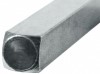
Square spindle 8
Edge n.1 - Corner 0.2 mm
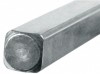
Square spindle 8
Edge n.2 - Corner 0.5 mm
Square spindle 10
Edge n.3 - Corner 1.0 mm
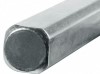
The choice of corner profile depends on the type of handle: a rounded corner facilitates assembly, while a sharp corner minimizes clearance and provides a tighter fit.
Materials
Selection and Quality of Raw Materials
Material selection is a key factor in ensuring consistent production quality, excellent machinability, and the mechanical performance required by the final application.
We use carefully selected steel grades based on their chemical composition, mechanical strength, machinability, suitability for heat treatment, and in-service performance.
Raw material selection
Quality of the raw material quality
Steel grades
- 11SMnPb37 — AVP
Category: Leaded free-cutting steel
Reference standard: EN 10277 / EN ISO 683-4
Steel number: 1.0737
Typical tensile strength: Rm 510–810 N/mm²
Main characteristics: Excellent machinability, high dimensional stability during machining, particularly suitable for high-volume production.
Typical applications: Turned components, precision metal parts, and mechanical components.
- 11SMnPb30 — LED 108
Category: Leaded free-cutting steel
Reference standard: EN 10277 / EN ISO 683-4
Steel number: 1.0718
Typical tensile strength: Rm 510–810 N/mm²
Main characteristics:
Similar properties to 11SMnPb37, with a lower sulphur content.
Typical applications:
Automatic lathe machining and components requiring excellent machinability and consistent production quality.
- 11SMn37 — AVZ
Category: Lead-free free-cutting steel
Reference standard: EN 10277 / EN ISO 683-4
Steel number: 1.0736
Typical tensile strength: Rm 510–810 N/mm²
Main characteristics:
Lead-free alternative to conventional free-cutting steels with good machinability.
Typical applications:
Components manufactured from lead-free materials or intended for applications subject to specific regulatory requirements.
- 11SMn30 — AVZ
Category: Lead-free free-cutting steel
Reference standard: EN 10277 / EN ISO 683-4
Steel number: 1.0715
Typical tensile strength: Rm 510–810 N/mm²
Main characteristics:
Lead-free free-cutting steel with mechanical properties comparable to other steels within the same family.
Typical applications:
Turned parts and mechanical components where lead-free material is required.
- 28SMnPb28 — PR60
Category: High-strength special free-cutting steel
Reference standard: To be confirmed according to the supplier’s technical datasheet
Steel number: To be confirmed
Typical tensile strength: Rm 630–890 N/mm²
Main characteristics:
Developed to provide higher mechanical strength than standard free-cutting steels while maintaining excellent machinability.
Typical applications:
Components subjected to higher mechanical loads where an optimal balance between machinability and strength is required.
- 16MnCr5
Category: Case-hardening steel
Reference standard: EN 10277 / EN ISO 683-3
Steel number: 1.7131
Typical tensile strength: Depends on the heat treatment condition
Typical surface hardness: Up to approximately 58–62 HRC after carburizing and quenching
Main characteristics:
Suitable for carburizing and quenching, providing high surface hardness while maintaining a tough and resilient core.
Typical applications:
Wear-resistant components, gears, spindles, shafts, and high-performance mechanical parts.
- AISI 303
Category: Free-machining stainless steel
Reference standard: EN 10088
Steel number: 1.4305
Typical tensile strength: Rm 600–890 N/mm²
Main characteristics:
Good corrosion resistance combined with excellent machinability due to its sulphur content.
Typical applications:
Components intended for corrosive environments, marine, nautical, and industrial applications.
- Technical Note
The values provided are indicative only and may vary depending on the supply condition, bar diameter, steel manufacturer, and any subsequent heat treatment.
For specific applications, the material is selected according to the technical requirements of the component and its intended service conditions.
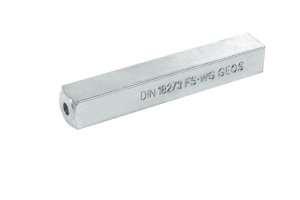
Markings
All our spindles can be marked with a customized logo or with the corresponding reference standards.
Laser marking
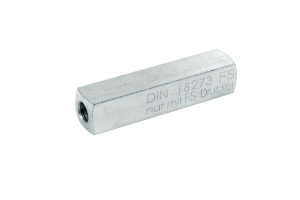
Marking by rolling
Surface treatments
All our products can undergo a surface treatment by means of electrolytic zinc plating.
By this process, the surfaces of all our items undergo a homogeneous zinc coating in order to improve their resistance against corrosion and wear.
Another advantage offered by the electrolytic zinc plating is that this is a very low-environmental-impact treatment.
Thanks to this process you can get a light-blue layer on the electrolytic zinc deposit, which is obtained in an alkaline, cyanized or acid environment. This kind of passivation does not contain Hexavalent Chromium.
This liquid passivation is based on Trivalent Chromium, which enables to obtain a fine decorative light-blue finishing besides high resistance against corrosion of pure Zinc. Completely free from Hexavalent Chromium and oxidising agents.
By this passivation process based on Trivalent Chromium you can get an iridescent-coloured layer. Its protective capacity, also tested by the standard ASTM, UNI-ISO proved an average resistance beyond 120 hrs. before any occurrence of white corrosion outbreaks.
The thickness of the zinc layer which has deposited on the surface can vary according to requirements. Our standard layer ranges between 8 and 12 microns.